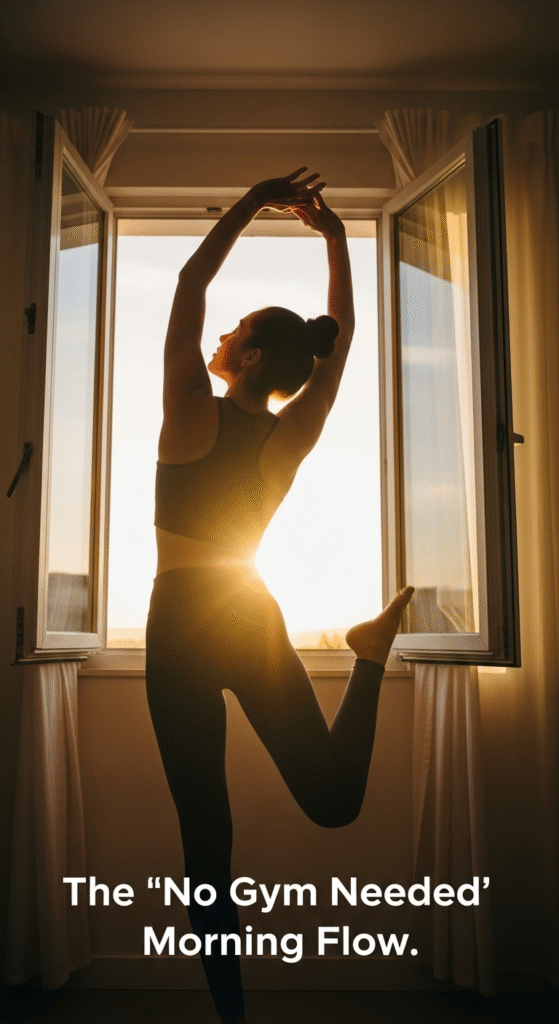
You don’t need a gym to build real strength — in fact, most people lifting every day still don’t have it.
Because true strength isn’t just muscle; it’s resilience, recovery, and control.
It’s what shows up when the music stops and the mirror’s gone — when life feels heavy and you still move.
There’s one rule behind it — a no-gym principle that elite athletes, soldiers, and movement scientists quietly live by.
It’s not about pushing harder. It’s about learning how strength actually works.
The Strength Illusion
Walk into any gym, and you’ll see effort everywhere — sweat, plates, mirrors.
But as Dr. Kelly Starrett, performance coach and author of Becoming a Supple Leopard, says:
“Strength without control is chaos. The goal isn’t to lift more — it’s to move better.”
We’ve confused muscle fatigue with functional strength.
Real strength is what you can use outside the gym — in your posture, focus, and movement under stress.
That’s why the strongest people aren’t always the biggest — they’re the most aware.
The No-Gym Rule: “Earn Your Movement First”
This is the rule: you don’t earn your reps until you earn your movement.
It’s the idea that strength isn’t built on intensity — it’s built on integrity.
If you can’t control your breath, spine, and hips through simple motions — walking, squatting, getting up from the floor — then lifting more only builds dysfunction faster.
As Dr. Andrew Huberman explains, “The body and brain are one continuous system. How you move changes how you feel, and how you feel changes how you perform.”
When you train quality before quantity, you’re building a body that lasts — not one that burns out.
Movement Is Medicine
According to a 2021 Harvard Health review, regular functional movement — walking, stretching, bodyweight training — improves insulin sensitivity, brain oxygenation, and even emotional regulation.
That means simple, intentional movement heals your nervous system while training it.
No gym membership required.
This is why military programs, pro athletes, and rehab centers alike are shifting from “workouts” to movement systems — strength built through stability, not strain.
The Hidden Power of Micro-Movements
You know what happens between your workouts?
That’s where your body either builds or breaks.
Every time you sit, stand, or stretch, your nervous system is adapting — reinforcing patterns of posture, tension, or release.
That’s why Dr. Peter Attia (longevity expert and author of Outlive) calls stability “the most underrated pillar of strength.”
He says:
“You don’t need more muscle. You need more control of the muscle you already have.”
Micro-movements — shoulder rolls, squats, soft stretches — are what recalibrate that control.
Strength Is a Nervous System Skill
Muscles only do what nerves tell them to.
If your nervous system is fatigued, unfocused, or overstimulated (hello, caffeine and phone notifications), your strength becomes chaotic output.
Movement resets that.
Each slow, deliberate motion — even bodyweight — sends feedback to your brain:
“We’re balanced. We’re capable. We’re safe.”
That feedback loop is what real strength is — regulated power, not random exertion.
The Body as a System, Not a Project
Modern fitness treats the body like a machine to optimize.
But functional strength is built through harmony, not hacking.
Ancient movement arts like Qigong, Yoga, and Calisthenics all point to the same truth:
Control the smallest motion well, and the big ones take care of themselves.
That’s why the no-gym rule matters — it brings you back to strength as awareness in motion, not performance under lights.
The “No-Gym Strength Reset”
Forget equipment — try this three-minute ritual to rewire your definition of strength.
Step 1 — The Ground Test
Start sitting or kneeling. Stand up without using your hands.
If it’s hard, that’s data — your strength isn’t missing, your mobility is.
Step 2 — The Breath Lock
Take one deep breath, hold mid-inhale, and move your arms overhead slowly.
That’s your nervous system under control — not panic.
Step 3 — The Functional Five
Each morning, do five slow squats, five hip circles, five shoulder rolls, and five breaths.
That’s it. Five reps that teach your body to wake up strong.
Because real strength isn’t measured in reps or mirrors.
It’s measured in how calmly and completely you can carry yourself — anywhere, under anything.