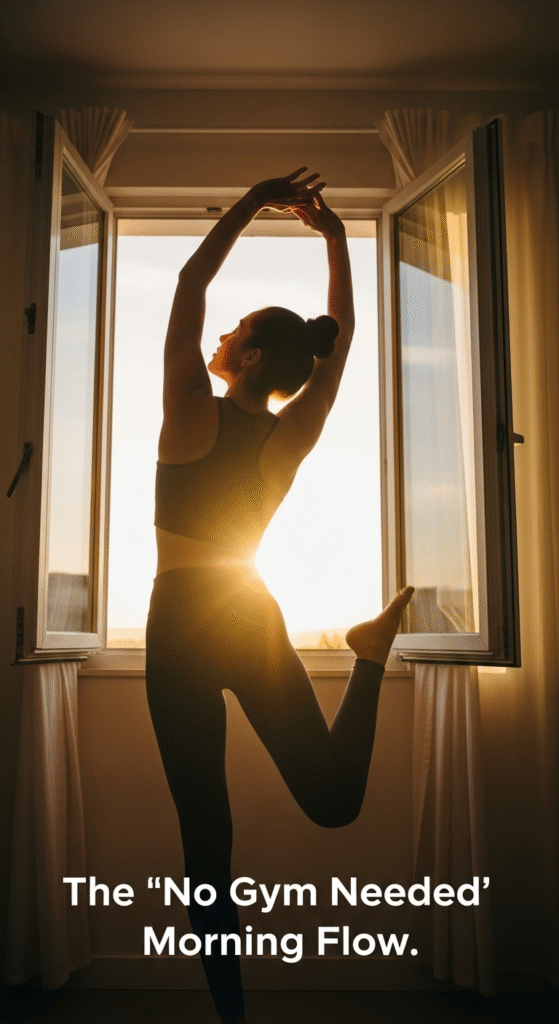
You don’t need a perfect gym plan, the latest smartwatch, or a diet overhaul — you need movement.
Most people chasing wellness tips or self-improvement hacks are skipping the simplest rule of all: walk more, sit less.
This isn’t about burning calories — it’s about resetting your biology. From better recovery to sharper focus, your body was designed to move. And when you stop overthinking fitness and start walking again, everything else starts to click.
Fitness Isn’t a Program — It’s a Posture
Modern fitness culture loves complexity:
Tracking macros, optimizing workouts, stacking supplements.
But the truth, according to movement expert Dr. Kelly Starrett, is simpler:
“Your body doesn’t need more exercise — it needs less sitting.”
Human physiology evolved around movement as a baseline, not as an occasional activity. The average hunter-gatherer walked 10–15 miles per day — not in workouts, but in living.
Today, the average office worker sits 10–12 hours a day, and studies show that even 60 minutes of exercise can’t undo that. It’s not about being lazy — it’s about being static.
Walking Is the Original Recovery Hack
You’ve probably heard that walking helps digestion, mood, or creativity.
But science goes deeper.
- Blood Flow: A 2018 study in Frontiers in Physiology found that light walking increases circulation to muscles, speeding up recovery and reducing inflammation.
- Brain Chemistry: Walking boosts dopamine and serotonin — the same feel-good chemicals that antidepressants target.
- Mental Reset: Stanford researchers discovered that walking increases creative output by 60%.
Dr. Andrew Huberman, neuroscientist at Stanford, explains:
“Forward movement triggers optic flow, which quiets the brain’s fear and stress circuits. Walking is literally built to calm you.”
That’s why a short walk often feels like a mental reboot — because it is one.
Sitting Is the Modern Cigarette
The phrase might sound dramatic, but it’s grounded in data.
The American Heart Association links prolonged sitting to higher risks of cardiovascular disease, type 2 diabetes, and even early mortality — regardless of workout frequency.
Why?
Because sitting too long:
- Slows down metabolism
- Weakens glute and core muscles
- Compresses spinal discs
- Increases insulin resistance
In simple terms: your body can’t process “stillness” for long durations.
You’re Not Lazy — You’re Deconditioned by Design
If walking feels exhausting, it’s not lack of motivation — it’s environmental conditioning.
We’ve engineered convenience to the point of paralysis: elevators, deliveries, endless screens.
Our brains have adapted to efficiency, not vitality.
The result? Mental fatigue, poor posture, and chronic low energy disguised as “burnout.”
As author James Clear (Atomic Habits) puts it:
“You don’t rise to the level of your goals; you fall to the level of your systems.”
And walking is one of the simplest systems you can rebuild.
The “Minimum Effective Dose” of Movement
You don’t need to hit 10,000 steps.
Research from the Journal of the American Medical Association (JAMA) shows that 7,000 steps a day correlates with a 50–70% lower mortality rate compared to sedentary individuals.
Even breaking movement into chunks matters:
- 2-minute walks every 30 minutes improve blood sugar levels
- A 10-minute walk after meals helps digestion and glucose regulation
- A 20-minute walk outdoors boosts focus and mood for up to 4 hours
In other words — walking isn’t extra exercise. It’s foundational medicine.
Mindset Shift: From Gym to Lifestyle
When you stop treating fitness as a “task” and start seeing it as a state of being, it becomes effortless.
You don’t have to “add” walking to your life — just integrate it:
- Take phone calls while pacing
- Walk during podcasts or lunch breaks
- Park further away
- Do evening reflection walks instead of scrolling
It’s movement without the mental friction of “training.”
Nature’s Role in Mental Healing
Walking outdoors, even briefly, amplifies the benefits.
Studies from Tokyo University on “forest bathing” (shinrin-yoku) found:
- A 12% reduction in cortisol (stress hormone)
- Lower blood pressure and heart rate
- Enhanced immune response through NK cell activation
Your biology recognizes natural environments as safety cues.
That’s why walking under trees feels restorative in ways a treadmill never can.
The “Walk More, Sit Less” Protocol
Forget optimization. Start integration.
Step 1 — Micro Walks Every Hour
Set a timer to stand and move for 2–3 minutes each hour. It keeps metabolism and circulation active.
Step 2 — One Daily 10-Minute Walk
Before or after meals, pick one time to walk daily — consistency matters more than duration.
Step 3 — Stack Movement With Routine
Calls, coffee breaks, morning thinking — make them mobile. Let walking become your default state, not your chore.
Step 4 — Track Feel, Not Steps
Notice how your body and mood shift after each walk. That awareness is your progress metric.
Because real strength doesn’t start in the gym — it starts the moment you decide to move more than you sit.
Your brain, body, and energy are all waiting for that first step.