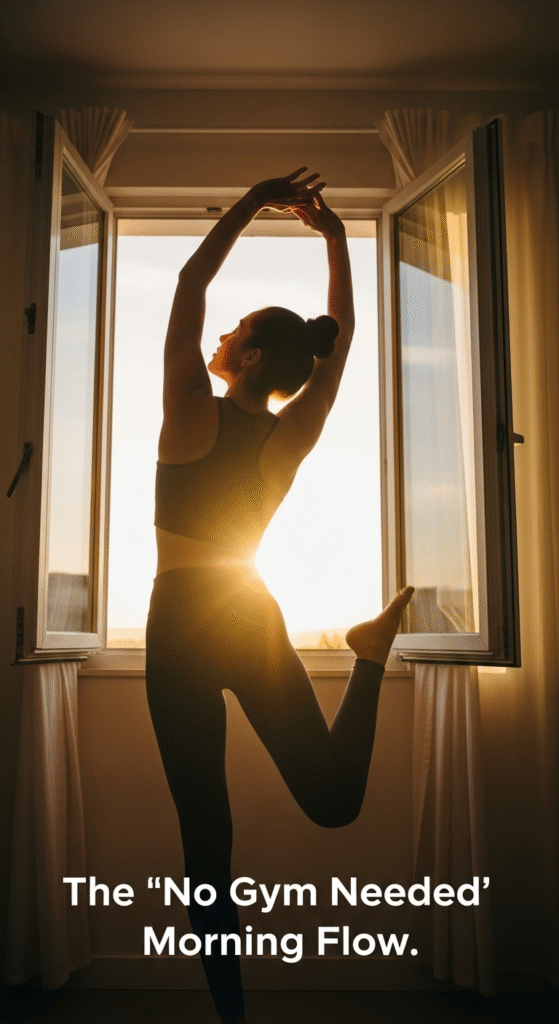
You’re not lazy — you’re just overcomplicating fitness.
You don’t need dumbbells, mirrors, or memberships. Your home is already your gym, you just haven’t learned how to see it that way yet.
If you care about wellness tips, mindset hacks, and living a healthy lifestyle that actually fits real life — start where you are, not where influencers film.
The Myth of “No Time” and “No Space”
The fitness industry has sold us a story: to get results, you need equipment, structure, and subscriptions.
But according to Dr. Stuart McGill, spine biomechanics researcher at the University of Waterloo, bodyweight training provides equal or greater benefit for joint health and core stability compared to most gym machines.
The real limitation isn’t space — it’s imagination.
Your living room floor can train mobility.
Your kitchen counter can support balance drills.
Your staircase is a built-in cardio zone.
“The best exercise is the one you’ll actually do,” says McGill. “Consistency, not machinery, drives strength.”
Why Home Movement Works
When you train at home, you remove the biggest barrier to fitness — friction.
No commute. No waiting. No intimidation.
It’s fitness stripped down to what matters: movement over environment.
A 2021 British Journal of Sports Medicine meta-analysis found that short bouts of bodyweight exercise performed at home improved overall cardiovascular fitness and insulin sensitivity nearly as effectively as structured gym sessions.
The science is clear: discipline beats environment.
Every Room Has a Workout
You don’t need a personal trainer to design this.
Just rethink what you already have.
Living Room — Mobility & Flow
- Push-ups, planks, or yoga stretches between furniture gaps.
- Use your coffee table edge for tricep dips.
- Sit on the floor instead of the couch for better hip flexibility.
Kitchen — Balance & Core
- Stand on one foot while waiting for coffee.
- Engage your abs every time you reach high shelves.
- Use counters for incline push-ups or wall sits.
Bedroom — Morning & Night Rituals
- 10 squats before brushing teeth.
- Gentle stretches before bed to signal recovery.
- Keep a resistance band by the bed — your five-minute circuit awaits.
Your house isn’t just a place to rest — it’s a system for daily activation.
The Psychology of “Accessible Fitness”
Neuroscientist Dr. Andrew Huberman often emphasizes the link between visual triggers and behavior.
When you see a mat, stairs, or even an open space, your brain registers an opportunity for movement — if you’ve conditioned it to.
This is why gym environments work: they’re filled with movement cues.
So, recreate them subtly at home.
Leave your yoga mat unrolled.
Hang resistance bands near your workspace.
Keep a water bottle within reach to reinforce hydration habits.
Each cue becomes a micro trigger for motion — a small reminder that health is within reach, literally.
Reframing What “Exercise” Means
The healthiest people aren’t obsessed with workouts — they’re fluent in movement.
They see stairs as squats, cleaning as cardio, stretching as ritual.
You don’t need 60-minute routines — you need movement moments spread across the day.
Research from the American Journal of Physiology shows that “exercise snacks” — short, high-effort bursts of 1–2 minutes — improve glucose control and heart health as effectively as longer sessions.
So next time you vacuum, do lunges.
When you reach overhead, stretch fully.
When you stand, stand tall.
Fitness isn’t what happens at the gym — it’s what happens between everything else.
Discipline Without Leaving the Door
Consistency starts when movement stops being an event and becomes a lifestyle.
That’s where home training wins — no travel, no scheduling, no performance pressure.
Dr. Kelly Starrett, mobility expert and author of Built to Move, calls this “environmental fitness.”
“Your space should invite motion, not confinement,” he says.
Your home doesn’t need to look like a gym — it just needs to invite curiosity.
The push-up bar is optional. The mindset of use is not.
The 10-Minute Home Activation Routine
No equipment. No excuses. Just start.
Step 1 — Pick a Room
Choose any spot — kitchen, bedroom, or hallway. Clear 2 square meters.
Step 2 — Set a Timer for 10 Minutes
You’re not training forever, just training now.
Step 3 — Move Continuously
Cycle through:
- 10 squats
- 10 push-ups (or on counter)
- 20 seconds plank
- 10 step-ups (stairs or stable chair)
Repeat until timer ends.
Step 4 — Anchor the Habit
Attach it to something you already do: after coffee, before shower, post-dinner.
This makes it automatic — not negotiable.
Step 5 — Celebrate Completion
Write it down, tick it off, or simply smile.
Because movement — done daily — beats motivation done occasionally.