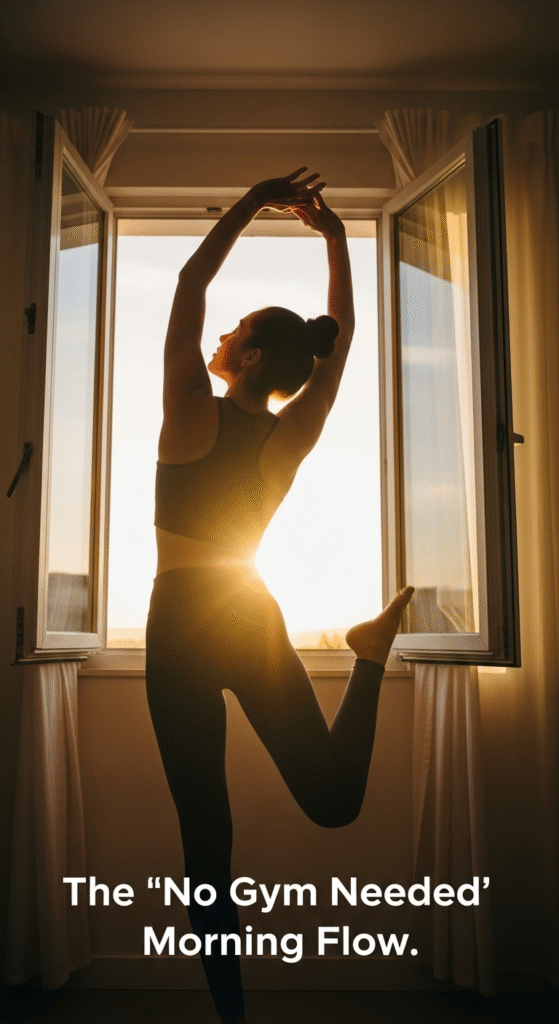
You don’t need a gym, a yoga mat, or fancy gear — just your body.
Most posture problems aren’t about weakness; they’re about disconnection.
The “no equipment” challenge is a mindset shift disguised as movement — a reminder that strength starts with awareness, not weight.
If you’ve been chasing better health, energy, or confidence, this might be the most important wellness tip you’ll ever try.
Posture Isn’t About Sitting Straight — It’s About Connection
When most people hear “fix your posture,” they imagine sitting up tall or pulling their shoulders back.
But that’s not posture — that’s posing.
According to Dr. Kelly Starrett, author of Becoming a Supple Leopard,
“Good posture is your ability to move freely and maintain alignment under load — not to stay stiff.”
Your body isn’t designed to hold one position; it’s designed to move often and efficiently.
The “no equipment” challenge rebuilds that natural connection — using nothing but bodyweight, awareness, and habit.
The Problem Isn’t Weak Muscles — It’s Dormant Ones
Hours of sitting make key postural muscles go offline —
your glutes stop firing, your core disengages, and your spine compensates.
That’s why you can train at the gym and still slouch at your desk.
A 2019 study in Frontiers in Psychology found that posture directly influences mood and cognitive performance — people with upright posture reported better focus, confidence, and even emotional resilience.
In short: fixing your posture doesn’t just change how you look.
It changes how your brain performs.
The “No Equipment” Challenge Explained
The idea is simple:
Spend five minutes a day reconnecting your body to gravity — no weights, no machines, just awareness and controlled movement.
Here’s what it looks like:
- Wall Angels (1 min): Stand with your back flat to a wall. Move your arms up and down slowly, keeping wrists and elbows against the wall.
- Glute Squeeze (1 min): While standing, tighten your glutes for 10 seconds, relax, and repeat.
- Hip Opener (1 min): Step one leg forward into a gentle lunge, focus on posture, and switch.
- Shoulder Rolls (1 min): Slow, exaggerated circles backward and forward.
- Core Breathing (1 min): Inhale deep into your belly, exhale while tightening your abs.
That’s it.
Five minutes.
Zero excuses.
The goal isn’t intensity — it’s consistency.
Why This Works
The secret isn’t in the movements — it’s in the nervous system reset.
By moving slowly and intentionally, you’re training your brain to reconnect with the muscles that posture depends on.
Neurophysiologist Dr. Andrew Huberman explains:
“Movement with awareness increases sensory feedback — it’s not just exercise; it’s a form of nervous system training.”
This is why bodyweight work can feel so grounding — it teaches your body to move as one system again, not as disconnected parts.
What Happens When You Do It Daily
After 1 week:
- Less tension in neck and shoulders
- Better focus during work
- More stable lower back
After 2–3 weeks:
- Naturally straighter posture
- Easier breathing
- Noticeable boost in energy and confidence
You don’t notice posture changing day by day — until one morning you catch your reflection and realize:
You’re standing taller, breathing deeper, and carrying yourself differently.
That’s not fitness. That’s awareness.
The 7-Day “No Equipment” Posture Reset
Step 1 — Pick a Time
Right after waking up or before bed works best.
Step 2 — Commit to 5 Minutes
You don’t need intensity. You need presence.
Step 3 — Focus on Form
Move slow, breathe deep, and imagine reconnecting each muscle.
Step 4 — Track Awareness, Not Progress
Notice how your body feels, not how it looks.
Step 5 — Let It Spill Into Daily Life
When you sit, walk, or type — recall that awareness.
Posture isn’t something you do; it’s how you exist.
You don’t need to buy anything to fix your posture.
You just need to remember that your body already knows how to stand tall —
you just have to remind it.