
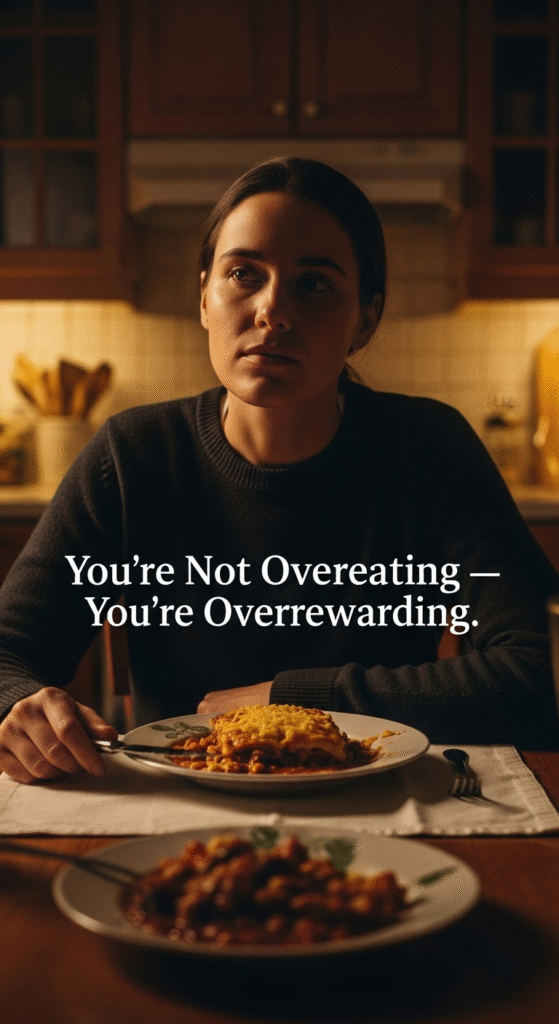
You don’t overeat because you’re weak — you overeat because your brain is doing its job too well.
Every bite of sugar, salt, or fat lights up your reward system like a slot machine.
The result? You’re not eating for hunger, but for dopamine — the feel-good signal that your body keeps confusing with satisfaction.
If you’ve been struggling with cravings or self-control, this isn’t about diet. It’s about understanding your wiring — the ultimate mindset hack for real change.
Your Brain Runs on Rewards — Not Calories
Modern food is engineered for pleasure, not nourishment.
Highly processed foods combine sugar, fat, and flavor enhancers in ways that overstimulate your brain’s reward centers.
Dr. Anna Lembke, professor of psychiatry at Stanford and author of Dopamine Nation, explains:
“We are wired to pursue pleasure and avoid pain — but when pleasure is too easily available, it leads to pain.”
That means the same brain chemistry that drives addiction can drive your food choices.
You’re not losing control — you’re being hijacked.
Hunger Isn’t the Signal You Think It Is
Most people assume hunger starts in the stomach.
In reality, it starts in the brain’s hypothalamus, which interprets a mix of signals — blood sugar levels, hormone balance, and yes, emotional state.
When you eat out of boredom, stress, or exhaustion, your brain is trying to self-regulate emotions, not satisfy hunger.
A 2022 study published in Nature Metabolism found that emotional stress triggers the same neural circuits as actual hunger — explaining why “comfort food” feels like medicine.
But here’s the twist:
The more you use food as emotional relief, the less effective it becomes — your brain builds tolerance, demanding more reward for the same relief.
You’re Not Craving Food — You’re Craving Relief
When you reach for a snack, your body often doesn’t need energy — your mind needs quiet.
Each bite floods the brain with dopamine, providing temporary escape.
But like any shortcut, it backfires.
That’s why you can feel guilty and unsatisfied after eating junk food — your brain got the hit, but not the healing.
Neuroscientist Dr. Jud Brewer, author of The Craving Mind, puts it clearly:
“The moment you pay attention to the craving itself — instead of reacting to it — you break the loop.”
So overeating isn’t a moral failure.
It’s a feedback loop your brain learned in survival mode — and you can teach it new rules.
The Reward System Isn’t Bad — It’s Misused
Dopamine isn’t the enemy. It’s the reason you chase goals, fall in love, and learn new skills.
The problem is what you attach it to.
The same neurochemical drive that pushes you toward cookies can push you toward cold showers, workouts, or creative projects — if you learn to redirect it.
Behavioral scientist Dr. BJ Fogg calls this “celebrating tiny wins” — linking small positive actions with reward signals.
“Emotions create habits. If you feel good after a behavior, your brain will repeat it.”
When you reward movement instead of consumption, your energy changes.
The Hidden Cost of Overrewarding
The real damage of overeating isn’t physical — it’s psychological desensitization.
Your baseline of pleasure gets higher and higher, making simple things — like water, sunlight, or slow meals — feel dull.
That’s why modern wellness isn’t just about eating less; it’s about retraining what feels good.
Your nervous system is capable of calm satisfaction — but it can’t find it in hyper-stimulation.
Healing isn’t about control; it’s about rebalancing reward.
The 3-Step “Rewire the Reward” Reset
Step 1 — Pause Before Eating
When you crave something, ask yourself: “Am I hungry or overstimulated?”
That split second of awareness changes everything.
Step 2 — Replace Reward, Don’t Remove It
Swap high-reward habits for low-reward ones with emotional payoff:
- A walk instead of a snack
- Cold water instead of soda
- Deep breathing instead of scrolling
Step 3 — Reward Awareness
Each time you resist reacting automatically, give yourself credit.
Your brain learns what feels satisfying — and awareness becomes the new dopamine hit.
You don’t need more discipline to stop overeating — you need a different definition of reward.
Once your brain stops mistaking comfort for nutrition, food becomes what it was always meant to be: fuel, not therapy.


