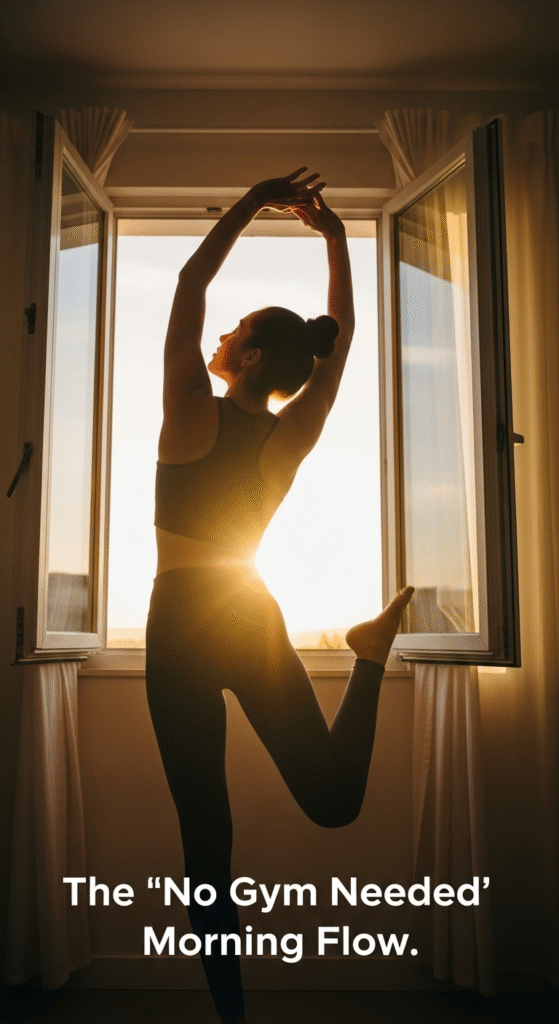
We’ve been trained to chase abs, not aliveness.
The wellness world sells “aesthetic” — but the real flex is energy.
Because what’s the point of looking fit if you wake up drained, crash by 3 p.m., and feel too tired to live your own life?
Here’s the truth: when you train for energy, not appearance, your body starts working with you — not against you.
The Energy Trap of Modern Fitness
Scroll through any fitness feed and you’ll see it: perfectly lit abs, sculpted arms, “what I eat in a day” reels.
But behind the filters lies a paradox — people look healthier than ever and feel worse than ever.
According to the American Psychological Association, nearly 60% of adults say they’re too exhausted to exercise regularly — even though they feel guilty for not doing enough.
That’s the aesthetic trap: chasing looks while burning through your life force.
Dr. Andrew Huberman, neuroscientist at Stanford, explains it simply:
“Your physical energy is directly tied to your nervous system balance. Overtrain or under-recover, and you’re draining the same fuel your brain needs to think, focus, and feel good.”
Why Training for Energy Changes Everything
When you train for energy, the goal shifts from how it looks to how it feels.
You’re no longer punishing your body — you’re partnering with it.
Instead of chasing calorie burn, you chase vitality.
Instead of exhaustion, you chase momentum.
Instead of restriction, you chase recovery.
Research from the Journal of Behavioral Medicine shows that people who exercise for internal goals (mood, focus, energy) are twice as likely to stay consistent than those who train for appearance.
Why? Because energy is felt immediately.
Aesthetic takes months.
The Shift from Image to Aliveness
When you stop chasing a body image and start chasing a body feeling, your entire wellness mindset flips.
Training for energy means:
- Prioritizing recovery as much as reps.
- Choosing walks, mobility, or yoga over burnout workouts.
- Sleeping like it’s your strongest supplement.
- Moving daily, not just in “sessions.”
As Dr. Kelly Starrett says in Built to Move:
“Longevity is the new performance. The goal isn’t more — it’s better.”
Energy training isn’t about breaking your limits — it’s about removing the limits that keep you tired.
The Nervous System Connection
Every workout talks to your nervous system.
When you’re constantly chasing “harder, faster, heavier,” your body lives in fight-or-flight — producing stress hormones like cortisol.
Short term? You might look lean.
Long term? You feel wrecked.
Training for energy means activating rest-and-digest — your parasympathetic system.
This is where healing, digestion, and creativity happen.
Simple forms of movement — walking, stretching, dancing — send powerful safety signals to your brain.
You’re telling your body, “I’m not in danger — I’m alive.”
That’s the energy upgrade aesthetic fitness will never give you.
Energy as the New Metric of Progress
What if your progress wasn’t measured in mirrors, but in mornings?
- How you wake up.
- How fast your mind clears.
- How deeply you sleep.
- How present you feel in the middle of chaos.
That’s what training for energy builds.
Harvard Medical School’s Dr. John Ratey, author of Spark: The Revolutionary New Science of Exercise and the Brain, writes:
“Exercise is the single most powerful tool to optimize brain function — more effective than any pill for mood, attention, and resilience.”
In other words, when you move your body right, your mind upgrades itself.
The Aesthetic That Comes Anyway
Here’s the irony: when you train for energy, aesthetic comes as a side effect.
You move more, recover better, eat intuitively, and sleep deeper.
Your body naturally aligns with how it’s designed to perform — strong, lean, and grounded.
Energy-first training doesn’t make you look worse.
It just makes you stop obsessing — and that’s what makes it work.
The Energy Training Reset
Step 1 — Ask “Does This Give or Take Energy?”
Before every workout or wellness choice, pause.
If it drains you now and later, skip it. If it fuels you both ways, it’s the right move.
Step 2 — Anchor Movement to Mood
Pick one movement that instantly lifts you — a walk, stretch, or song dance.
Do it daily, not for fitness, but for energy regulation.
Step 3 — Protect Recovery Like Training
No energy = no results.
Sleep 7–8 hours, hydrate first thing, and cut screens an hour before bed.
That’s how you rebuild the nervous system that powers your willpower.
Step 4 — Redefine Progress
Forget “before and after.”
Measure how clear, grounded, and alert you feel.
That’s your real transformation metric.
Train for energy, and your body becomes what it was meant to be — a power source, not a project.