
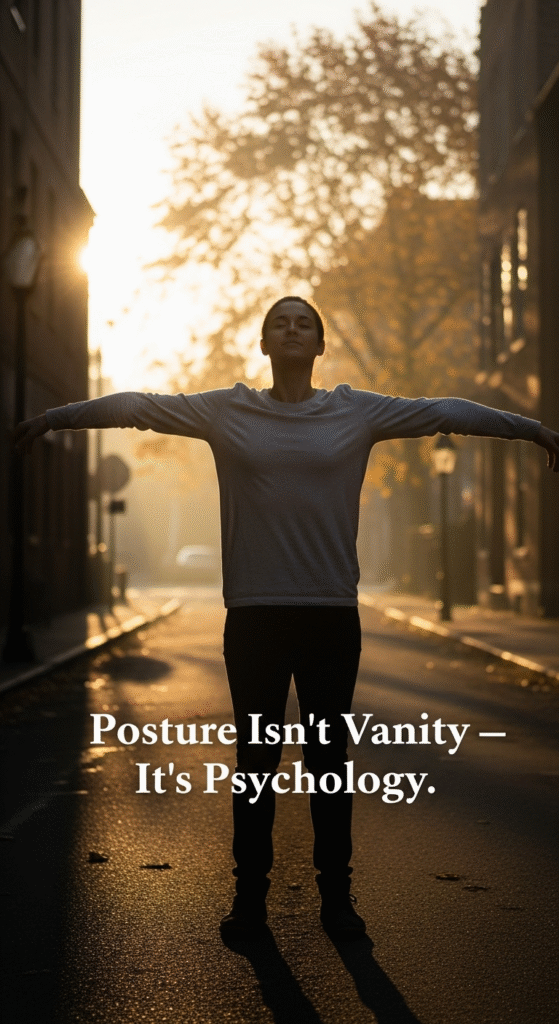
Posture isn’t about vanity — it’s about vibration.
The way you hold your body shapes the way you think, feel, and act.
You can spend hours on mindset hacks or self-improvement routines, but if your body language says “collapse,” your brain listens.
This isn’t fitness — it’s psychology you can see.
The Hidden Language of the Body
Your body is constantly sending messages — not just to others, but to your own brain.
When you slouch, your body signals defeat, fatigue, or disconnection. When you stand tall, it signals readiness and confidence.
Dr. Amy Cuddy, a social psychologist at Harvard, became widely known for her research on body posture and confidence.
Her study found that “power poses” — open, upright postures — can elevate testosterone and lower cortisol, increasing confidence and focus.
“Our bodies change our minds, and our minds can change our behavior.” — Amy Cuddy
Even if the “power pose” effect is debated, one truth remains: your posture reflects your internal state — and reinforces it.
Why Posture Is Psychological, Not Physical
Think about what happens when you’re anxious or defeated: your shoulders curl, your chest sinks, your breath shortens.
That’s not just emotion — that’s body memory.
Your nervous system interprets these signals as danger or stress, keeping you in fight-or-flight mode.
Standing tall, on the other hand, opens the chest, deepens the breath, and activates the parasympathetic system — your body’s natural calm response.
It’s not that confident people stand tall.
It’s that standing tall teaches your brain to feel confident again.
Your Body Stores Every Emotion
Your posture isn’t static — it’s a reflection of your story.
Trauma, anxiety, and burnout literally reshape how we carry ourselves.
A 2017 study in Frontiers in Psychology found that upright posture improved mood and decreased fatigue in people with mild depression.
The researchers concluded that body alignment can influence emotional resilience and motivation — without a single therapy session.
This is why “fixing posture” can feel emotional.
You’re not just opening your shoulders — you’re releasing old protection patterns your body has been holding onto.
Confidence Isn’t in the Mind — It’s in the Body
Confidence doesn’t start as a thought. It starts as a physical signal your brain can read.
When you straighten up, take a full breath, and meet the world eye-level, your body tells your mind: “We’re safe. We belong here.”
Dr. Andrew Huberman, neuroscientist at Stanford, explains:
“Posture and visual focus directly influence brain state. Looking down and collapsing posture signals passivity, while upright posture promotes alertness and engagement.”
Your nervous system takes cues from how you move — not what you think.
That means self-assurance isn’t a mindset; it’s a bodyset.
The Posture-Emotion Feedback Loop
Every emotion creates a posture — and every posture can recreate an emotion.
- Stress → tight shoulders
- Sadness → curved spine
- Confidence → open chest, relaxed neck
- Calm → slow breath, steady stance
Once you recognize this loop, you can use it intentionally.
When you feel low, move your body as if you felt strong.
Your physiology will do the rest.
This isn’t “fake it till you make it.”
It’s signal it till you feel it.
The 3-Minute Posture Reset
Step 1 — Find Neutral Ground
Stand barefoot. Feel your weight evenly on both feet. Let your knees unlock.
Step 2 — Reset the Chain
Roll your shoulders back. Open your chest slightly. Breathe deeply through your nose.
Let your head rise naturally, as if pulled upward by a string.
Step 3 — Anchor the Feeling
Close your eyes for 10 seconds and notice how this posture feels — lighter, calmer, more awake.
This is your real baseline — your body’s version of “present.”
Repeat this every time you catch yourself folding inward — before a meeting, a workout, or even an argument.
You’ll notice something profound:
You’re not “correcting” posture — you’re returning to alignment — physically, mentally, and emotionally.
Your body is your first language, your first story, and your first form of mindset work.
When you learn to hold yourself differently, you stop chasing confidence — you start embodying it.


