
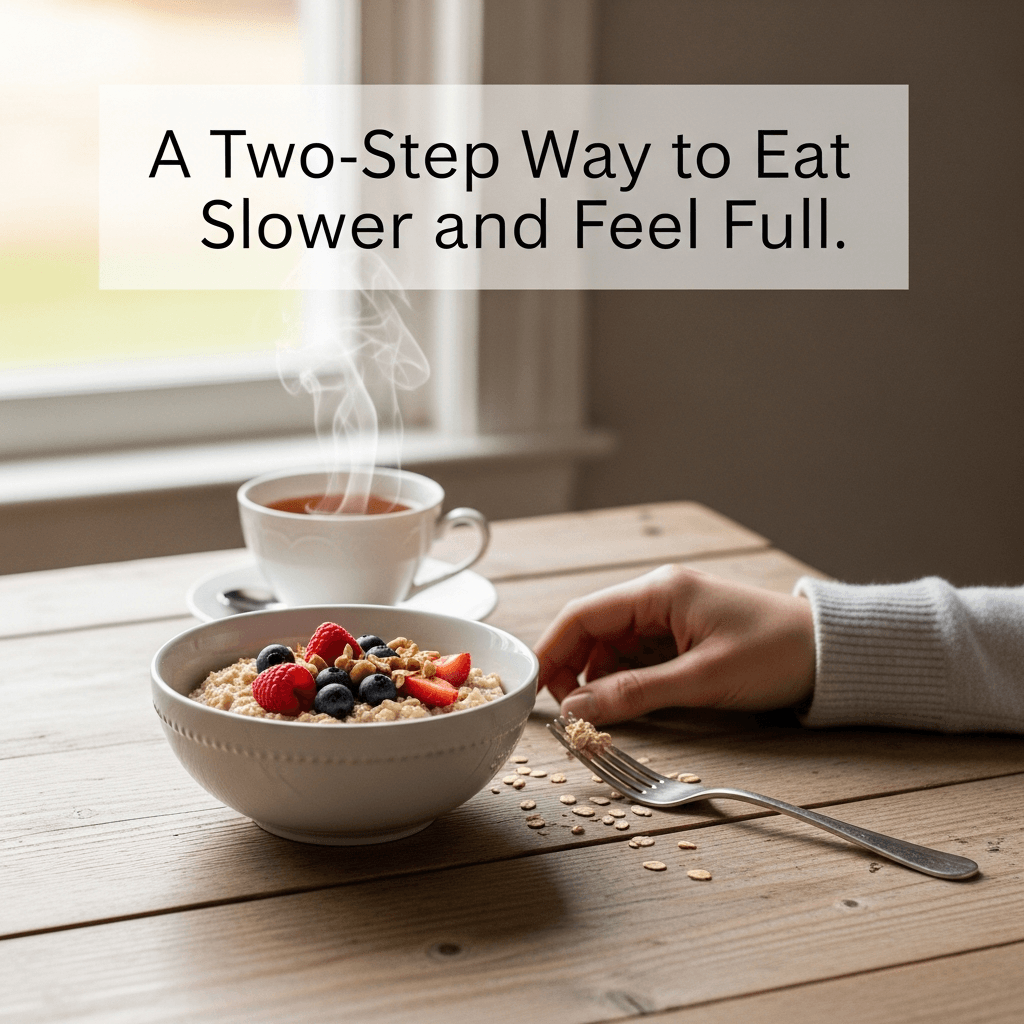
You don’t need another diet rule — you need to slow down.
Most people eat fast not because they’re hungry, but because their brains never get a chance to catch up.
Here’s a simple, two-step habit that retrains your pace and helps your body signal fullness naturally.
Step 1: Pause Before the First Bite
The first bite sets the rhythm.
When you rush into eating, your nervous system stays in “go mode,” and digestion never gets the calm start it needs.
Before your first forkful, try this:
- Take one deep breath.
- Look at your food.
- Smell it.
That 5-second pause switches your body from fight-or-flight to rest-and-digest.
According to Harvard Health, mindful eating activates the parasympathetic system, which allows your stomach to release enzymes and your brain to process satiety signals sooner.
Translation: you’ll feel satisfied with less food — without even trying to “eat less.”
Step 2: Set Down the Fork Every Few Bites
Once you start eating, the easiest way to slow down is to interrupt your automatic rhythm.
After every 3–4 bites, simply put your fork down.
You can sip water, talk, or take a breath — anything that forces a short pause.
This breaks the unconscious pattern of “bite-chew-swallow-repeat,” giving your body time to catch up.
Studies show that it takes about 20 minutes for fullness hormones (like leptin and CCK) to reach your brain — so if you finish your meal in 8 minutes, your body doesn’t stand a chance to tell you you’re full.
Why This Works
Slower eating isn’t about restriction — it’s about reconnection.
When you eat at a human pace, you notice texture, flavor, and satisfaction again.
It stops being a blur of bites and starts feeling like nourishment.
Your body is incredibly smart.
It’s just waiting for you to give it time to speak.
Action Plan: Try the Two-Step Method Today
- Pause before eating — one deep breath before the first bite.
- Set down your fork every few bites.
That’s it.
No counting, no tracking, no guilt.
Just presence — and the quiet realization that you’re full sooner than you think.


