
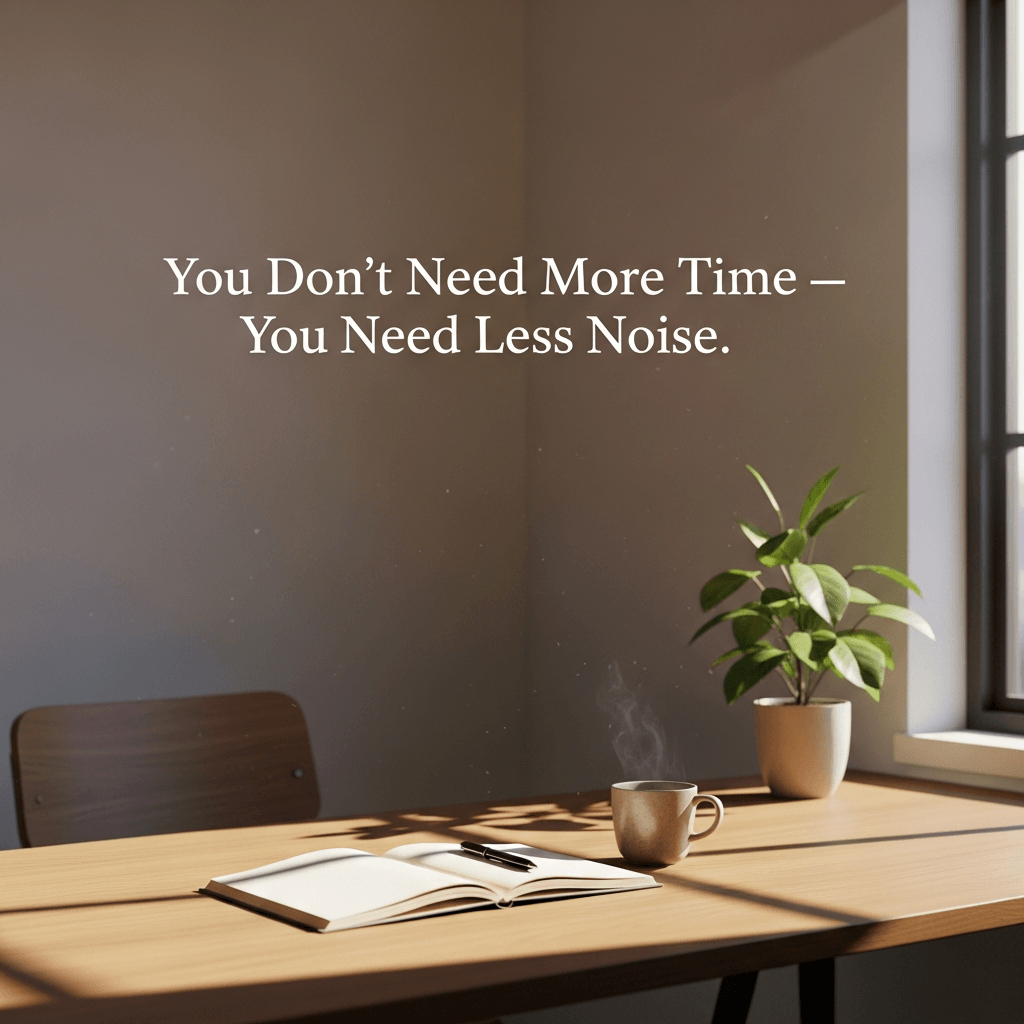
You keep telling yourself you need more time — but what you really need is less noise.
Your focus isn’t broken; it’s buried under notifications, opinions, and distractions disguised as productivity.
The real solution isn’t time management — it’s attention management.
The Myth of “Not Enough Time”
Everyone has the same 24 hours. The difference isn’t time — it’s what fills it.
We fill our days with mental clutter: checking messages mid-task, jumping between tabs, answering “just one more” email.
According to Gloria Mark, researcher at UC Irvine, the average worker switches tasks every 47 seconds, and it takes over 23 minutes to regain full focus.
So it’s not that you’re lazy or unmotivated — you’re simply overstimulated.
Your brain was never meant to process a constant stream of digital noise.
Noise Is the Modern Form of Stress
Noise isn’t just sound — it’s input overload.
Every scroll, ping, and ad you see triggers a micro-stress response.
Over time, this keeps your nervous system in a state of low-grade alertness — always half-anxious, half-distracted.
Neuroscientist Dr. Daniel Levitin explains in The Organized Mind that information overload depletes cognitive energy, the same way physical exertion drains muscle strength.
When your brain is always “on,” rest stops feeling restful, and focus becomes impossible.
You don’t need more discipline. You need fewer inputs.
Why Stillness Feels Uncomfortable
When you finally stop scrolling or working, your mind panics.
That silence you feel? It’s not boredom — it’s withdrawal.
You’ve conditioned your brain to crave noise as a way to avoid stillness, reflection, or discomfort.
But here’s the paradox: that stillness is where clarity hides.
Once you stop reacting to everything, you can finally hear yourself think.
Dr. Jud Brewer, neuroscientist at Brown University, describes this as “unwinding the habit loop.”
When you resist the impulse to fill silence, your brain slowly relearns peace as a normal state.
The Power of Quiet Focus
When you reduce noise, you create bandwidth — mental space for deep thought and calm awareness.
That’s why:
- A walk without music feels restorative.
- Writing in silence brings unexpected ideas.
- Even five minutes of still breathing resets your system.
Noise steals clarity. Silence returns it.
And once you experience that, you stop chasing time altogether.
Action Plan: Subtract the Noise
- Start with one “no-input” window — 10 minutes a day with no phone, no music, no screen.
- Mute what doesn’t matter. Notifications, group chats, background TV — off.
- Replace noise with movement or presence. Walk, stretch, breathe — no soundtrack needed.
- Notice what happens. The first thing you’ll feel is restlessness. The second is relief.
You don’t need more time to find peace — you just need less of what keeps you from it.


