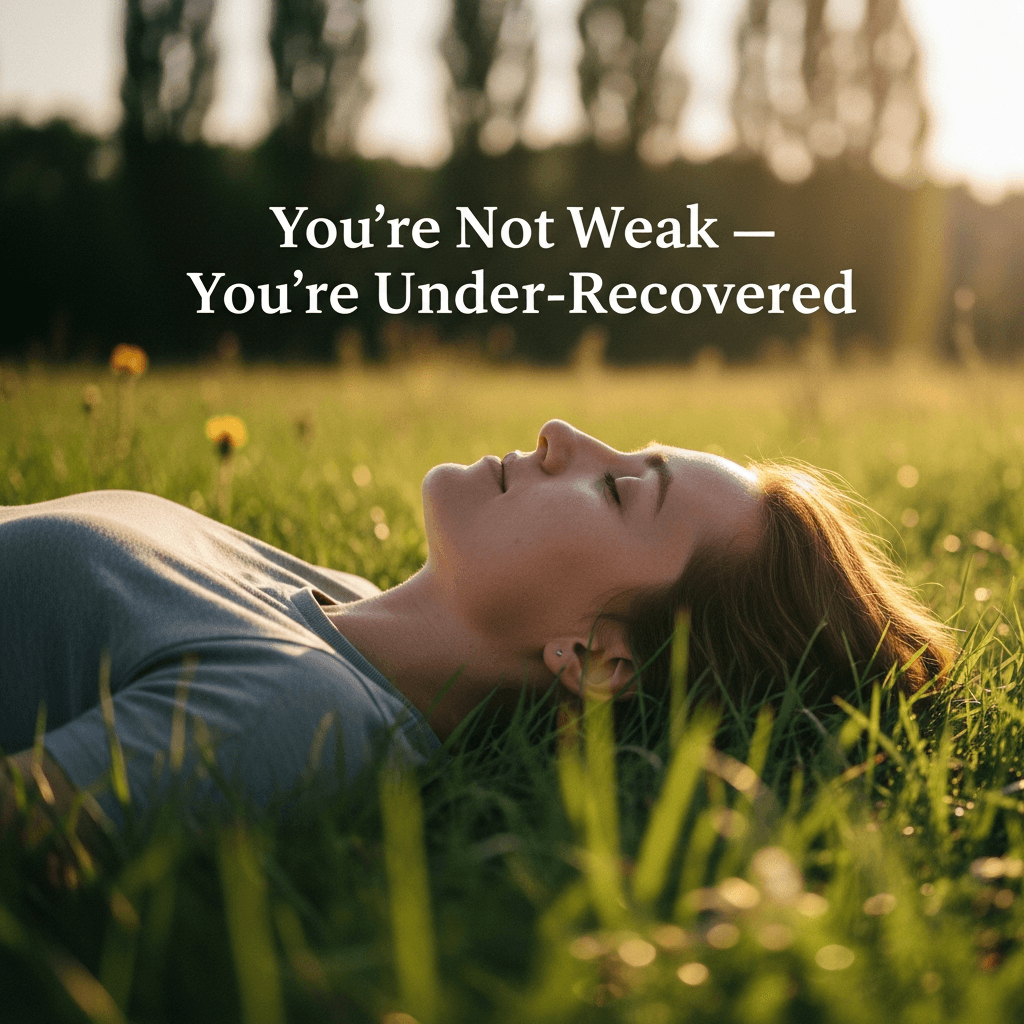
You think you’re lazy. You think you’ve lost your drive.
But what if you’re not unmotivated — you’re under-recovered?
Because exhaustion wears the same mask as weakness. And most people try to fix fatigue with more effort, not more rest.
The Hidden Cost of Constant Output
You’re told to “push harder,” “stay consistent,” and “show up daily.”
But no one tells you that progress depends on recovery as much as action.
Athletes understand this — they train hard, then rest harder.
Yet in daily life, we treat recovery like a luxury, not a requirement.
Sleep debt, emotional stress, overstimulation — they pile up quietly, dulling your strength until even small tasks feel heavy.
You’re not broken. You’re simply running on an empty nervous system.
The Science of Recovery Debt
Dr. Matthew Walker, author of Why We Sleep, explains that chronic sleep deprivation doesn’t just cause tiredness — it impairs cognitive control, emotional balance, and motivation.
When your body lacks rest, your prefrontal cortex (focus and decision-making) shuts down faster, while your amygdala (stress and reactivity) stays overactive.
That’s why you can’t “willpower” your way out of burnout — your biology has already hit its limit.
Add caffeine, constant screen time, and zero stillness, and you’re forcing your system to sprint with no finish line.
Recovery Isn’t Laziness — It’s Maintenance
You wouldn’t expect a phone to work without charging it, yet that’s exactly how we treat ourselves.
Rest isn’t a reward for productivity — it’s the foundation of it.
Recovery happens in layers:
- Physical: sleep, hydration, movement.
- Mental: quiet time, reduced input, space to think.
- Emotional: connection, laughter, self-compassion.
When one layer collapses, the others strain to compensate. Eventually, everything feels hard — not because you lack strength, but because you’re out of sync.
The “Recharge Routine” Framework
Instead of chasing more output, build in micro-recovery cycles throughout the day:
- 10-Minute Disconnect: no screens, no noise, just breathing or walking.
- 1-Hour Restoration: sunlight, stretching, or journaling to slow the mind.
- 8-Hour Sleep Window: non-negotiable, even if imperfect.
Small acts of recovery compound like training.
They refill your energy before depletion becomes dysfunction.
Why “More Effort” Isn’t the Answer
When you feel weak, your instinct says do more.
But sometimes strength returns only when you do less — better.
Recovery is what converts effort into growth.
Without it, you’re just breaking yourself down faster than you rebuild.
Rest Is Resistance
In a world obsessed with output, choosing recovery is rebellion.
It’s saying, “I’m not falling behind — I’m rebuilding.”
You’re not weak — you’re under-recovered.
And once you give yourself permission to rest, your strength won’t just return — it’ll multiply.