
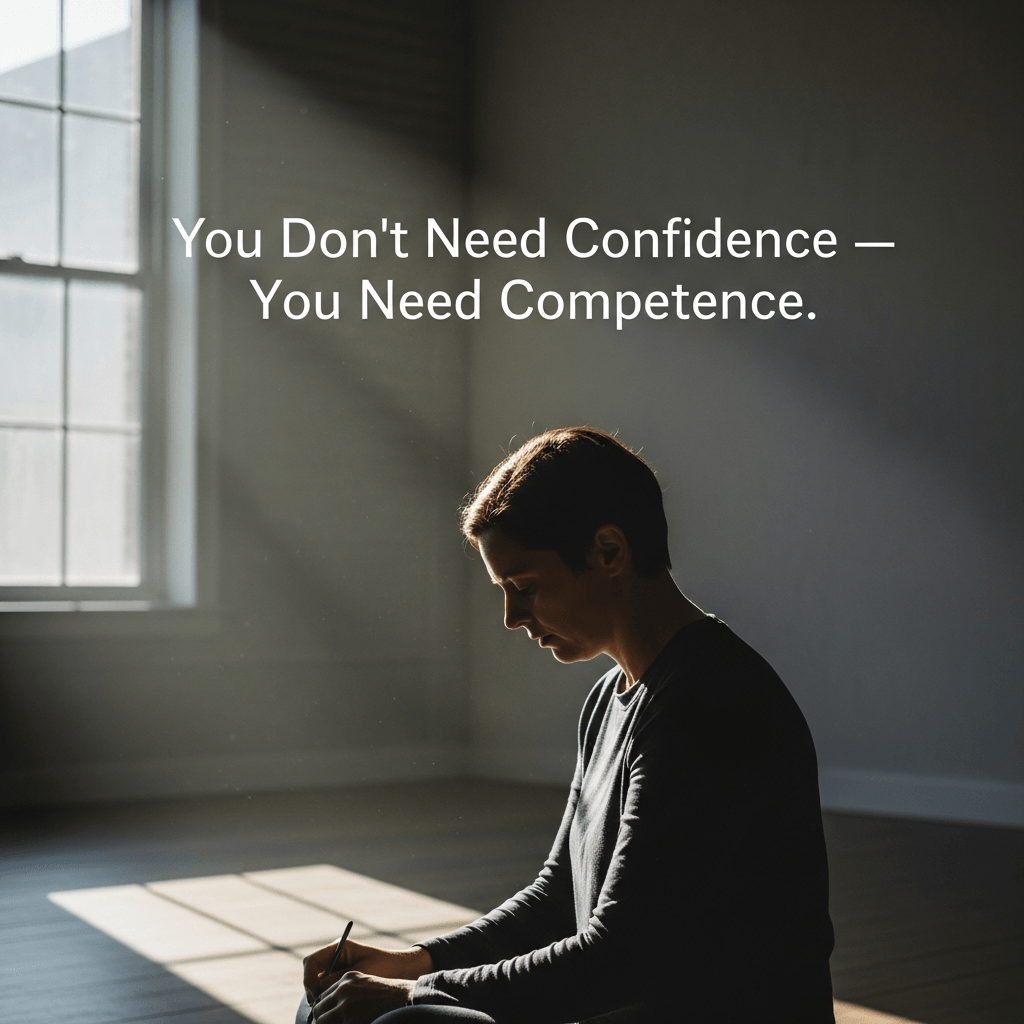
Confidence is overrated.
What really changes your life isn’t how much you believe in yourself — it’s how much you trust yourself.
And that trust doesn’t come from pep talks or affirmations. It comes from competence — doing, learning, and repeating until the fear fades.
The Confidence Myth
We’re taught to chase confidence like it’s a prerequisite for success.
But psychologists like Dr. Albert Bandura, who developed the theory of self-efficacy, found that belief follows mastery — not the other way around.
You don’t become confident then act; you act until confidence has no choice but to show up.
Confidence without competence is fragile — it collapses under pressure.
Competence, on the other hand, is earned through small repetitions that prove, again and again: “I can handle this.”
The Science of Competence
Neuroscientist Andrew Huberman explains that skill repetition literally rewires your brain — creating efficiency in the neural circuits that control focus and performance.
Each time you practice a task, your brain reduces uncertainty, replacing anxiety with clarity.
That’s why elite performers don’t chase hype — they chase feedback.
Competence is calm. It’s the quiet strength that comes from knowing you’ve done the work.
Why Confidence Feels Flimsy
Because it’s emotional — and emotions fluctuate.
Some days you wake up energized, other days you don’t.
If your drive depends on confidence, you’ll crumble when doubt hits.
But when you rely on competence, doubt becomes irrelevant. You know what to do because you’ve built the reps.
Competence is consistency disguised as calm.
How to Build Competence (Without Waiting to Feel Ready)
- Pick one thing to improve daily.
Skill, habit, or mindset — just one. - Track small wins.
Competence grows in the data of your effort. - Review, don’t judge.
Self-trust isn’t built through perfection; it’s built through iteration. - Repeat until confidence is obsolete.
Because real confidence isn’t loud — it’s earned.
Confidence Follows Repetition
Stop trying to feel brave. Start trying to get better.
When you move with skill, belief becomes automatic.
Confidence is a byproduct — competence is the foundation.
You don’t need to feel capable to start.
You need to start — that’s how you become capable.


