
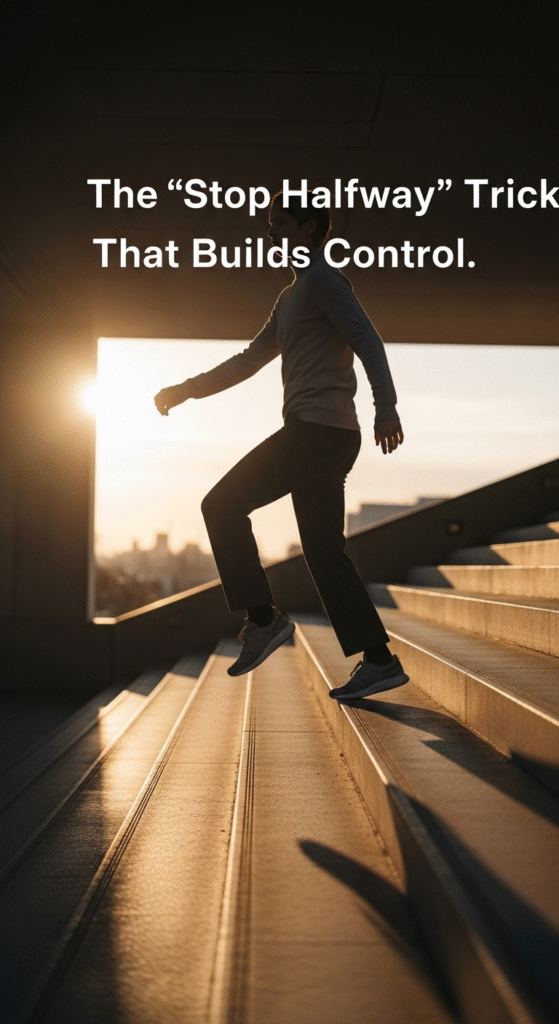
Trying harder often backfires. The real secret to self-control isn’t pushing past limits — it’s learning to stop before exhaustion. The “Stop Halfway” trick rewires your habits, strengthens focus, and teaches your brain that restraint is power, not punishment.
The Paradox of Control
Most people think discipline is about going all in. More reps, more hours, more willpower. But research shows that overextension depletes self-control, making it easier to fail the next time.
Dr. Roy Baumeister, psychologist behind the concept of ego depletion, explains:
“Self-control is like a muscle. If you overwork it without rest, it weakens.”
The trick? Stop while you still have a little left in the tank. That’s when your brain learns mastery, not fatigue.
How Stopping Halfway Works
Stopping halfway isn’t about quitting. It’s about calibrated effort:
- You do the work while your energy is high.
- You end on a success, not struggle.
- You build a sense of control over your actions.
James Clear calls this the “margin of victory” principle — leaving room ensures the habit sticks. When you always finish fatigued, your brain associates the activity with pain. Stop early, and the brain associates it with success.
The Science Behind the Habit
Neuroscience shows that dopamine is released during completion — but intensity isn’t required. Finishing before failure keeps reward circuits engaged without triggering stress or cortisol spikes.
Applied consistently, stopping halfway:
- Boosts focus and clarity
- Reduces burnout
- Strengthens long-term habit adherence
It’s not laziness — it’s a smarter way to train your mind and body.
Practical Applications
You can apply “Stop Halfway” across life:
- Exercise: End your set before muscle fatigue.
- Work: Wrap up a task while still energized.
- Diet: Pause eating before fullness to train restraint.
- Mindset: Close your journal while curiosity is still high.
The pattern: start intentionally, stop intentionally. Control grows in the margin, not at the extreme.
Action Guide: Build Self-Control Daily
- Pick one activity today where you usually push to exhaustion.
- Commit to stopping at 50–70% of usual effort.
- Notice how it feels — mentally and physically.
- Repeat tomorrow, slowly increasing awareness, not intensity.
The brain learns self-mastery fastest when it associates action with success — not struggle. Halfway is where consistency and control are born.


