
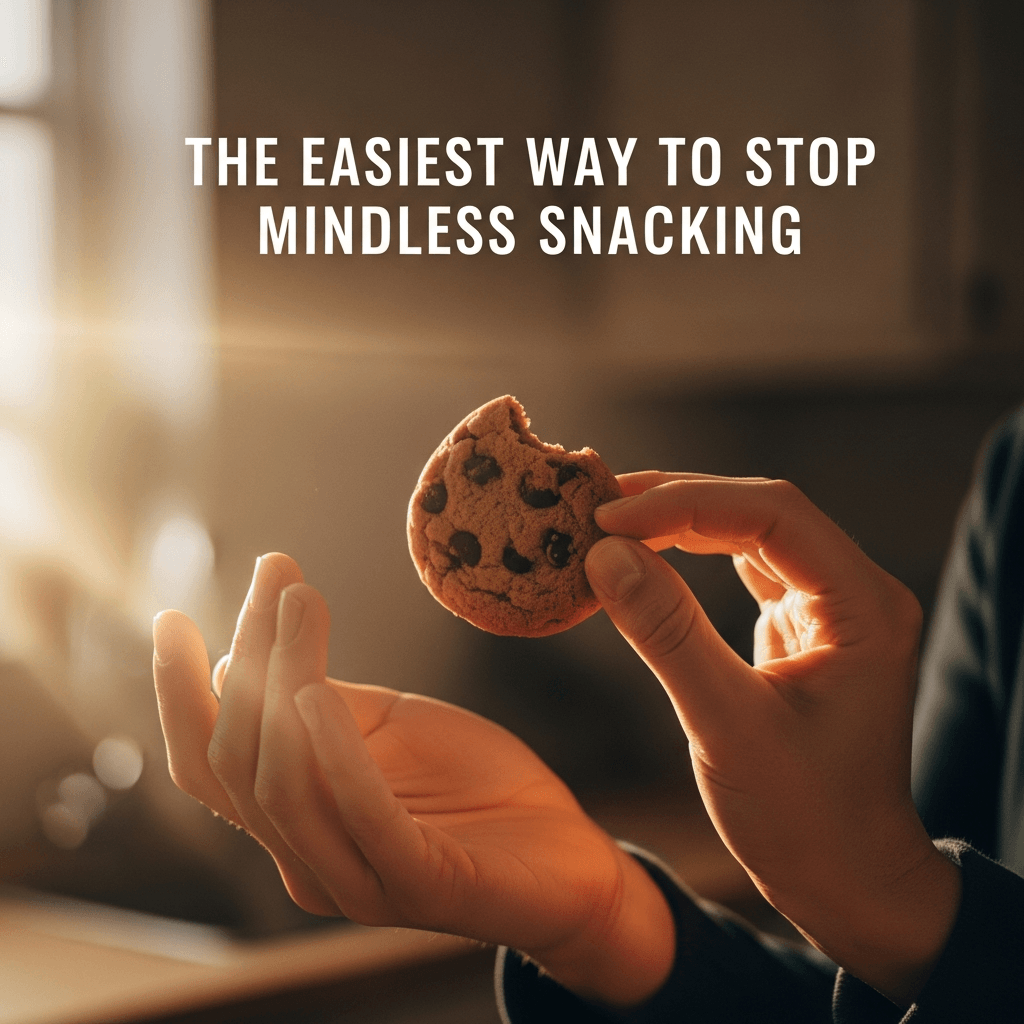
You’re probably not hungry — you’re just bored, stressed, or scrolling.
Mindless snacking isn’t about food; it’s about distraction.
The good news? You don’t need willpower to stop it — just awareness.
The Science Behind Mindless Eating
Studies from Cornell University’s Food and Brand Lab found that we make over 200 food decisions a day, most without realizing it.
When you eat while distracted — watching TV, working, or scrolling — your brain’s “satiety signal” never fully registers.
That means your body keeps eating long after it’s full.
Dr. Brian Wansink, the researcher behind this study, called it “the mindless margin” — the subtle overeating that happens when we’re not paying attention.
It’s not gluttony; it’s autopilot.
The Real Trigger Isn’t Hunger
If you’ve ever opened a snack without thinking, you’ve experienced what psychologists call cue-based behavior.
You saw food → felt an emotion → acted.
The trigger wasn’t hunger — it was emotion.
- Boredom: “I just need something to do.”
- Stress: “I deserve a break.”
- Fatigue: “I need energy.”
Once you start seeing the pattern, the power shifts.
You can interrupt the cycle before the bag even opens.
The One-Minute Pause Technique
Here’s the simplest, most effective trick: Pause for 60 seconds before eating anything.
Ask yourself:
- “Am I hungry or just restless?”
- “Will food actually solve this feeling?”
- “What else could help right now?”
If you still want the snack after a minute — go ahead.
But most of the time, the urge fades, because awareness broke the loop.
What Mindful Snacking Looks Like
Mindful eating isn’t rigid — it’s intentional.
You don’t have to give up chips or cookies forever.
You just have to experience them fully.
Try this:
- Eat without screens.
- Notice texture, smell, and flavor.
- Stop halfway and check how your body feels.
When you eat slowly and consciously, your brain gets time to register fullness — no guilt, no excess, no autopilot.
The Easy Reset Habit
To make this automatic:
- Keep snacks out of reach. Not forbidden — just out of sight.
- Drink a glass of water first. Thirst often disguises itself as hunger.
- Use the one-minute pause every time the craving hits.
It’s not about restriction. It’s about reconnection.
You’re teaching your brain to ask again: “Do I actually want this?”
Closing Thoughts
You don’t have to fight your cravings — you just have to notice them.
Awareness, not willpower, ends mindless snacking.
And once you stop eating to escape your emotions, food becomes what it was always meant to be: nourishment, not noise.


