
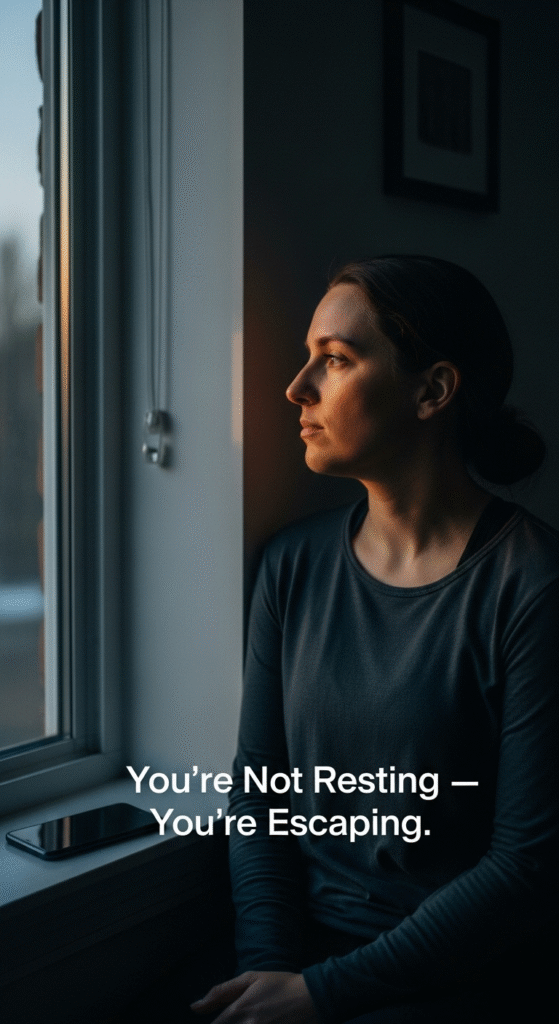
Scrolling isn’t rest. Netflix isn’t rest. Even lying down can be mental work if your brain’s still sprinting. Most people think they’re resting — but they’re really escaping. True rest doesn’t numb you; it restores you.
The Illusion of Rest
We confuse escape with recovery.
When you say, “I need to relax,” what you often mean is, “I need to stop feeling this way.” So you reach for distractions — the phone, the show, the snack. But those things don’t reset your nervous system; they just silence it temporarily.
“Rest is not doing nothing,” writes author Alex Soojung-Kim Pang.
“It’s doing something that restores you.”
Real rest is intentional, not accidental.
The Science Behind Real Recovery
Your brain doesn’t recharge by shutting off — it restores through shifts in attention.
That’s why a quiet walk feels more rejuvenating than hours of scrolling. You’re not overstimulating your senses; you’re letting them breathe.
Neuroscientists call this “default mode activation” — when your mind wanders gently, not anxiously. It’s where creativity, emotional processing, and deep calm happen. You can’t access that while binging content or doomscrolling through noise.
How Escapism Masquerades as Rest
Escapism feels like relief — at first.
But notice what happens after: guilt, fatigue, irritability, or a lingering sense of emptiness. That’s your body saying: You didn’t rest. You just paused the discomfort.
It’s like closing a laptop without saving your work — the system never really shuts down.
Your mind needs actual recovery, not distraction loops.
The Three Forms of Real Rest
- Physical Rest: Stillness that relaxes muscles — lying down, stretching, or breathing deeply.
- Mental Rest: Detaching from input — reading, journaling, or quiet reflection.
- Emotional Rest: Allowing feelings to surface without judgment — solitude, prayer, or nature walks.
When you integrate all three, you reset your internal systems instead of just muting them.
How to Tell the Difference
Ask yourself one question:
“Do I feel more alive after this?”
If your “rest” leaves you dull, heavy, or disconnected — it’s escape.
If it leaves you lighter, grounded, and mentally clear — that’s recovery.
It’s not about guilt-tripping your downtime; it’s about reclaiming it.
Your energy doesn’t just come from sleeping or eating right. It comes from giving your nervous system moments of quiet, not consumption.
Ritual for Real Rest
Try this tonight instead of defaulting to your phone:
- Dim the lights.
- Sit in silence for 5 minutes.
- Notice your breathing.
- Ask yourself: What do I need right now?
You’ll realize rest isn’t something you find — it’s something you practice.


